
The Mega-Cap Supply Shock: SpaceX & Anthropic
Assessing the Systemic Capital Drain and Market-Wide Supply Waves from IPO Giants

Friday’s tape gave us the first clear glimpse of a momentum flush. It plays like a one-off episodic event for now, but the massive wall of upcoming equity supply from mega-IPOs like SpaceX and Anthropic this fall could easily upend the market's trajectory. Meanwhile, the clock is ticking on the geopolitical headline bluff; the market will eventually stop buying into Trump's "imminent peace deal" rhetoric, setting the stage for energy prices to rerate significantly higher. Structurally, we are tracking the monthly Quad 3 transitions slated for July and August, an environment where energy should comfortably resume its march upward. There are a lot of moving parts to digest, and this summer is guaranteed to keep us on our toes. Stick to the signal.
"Of course, it doesn't matter who is selling. If you're selling, somebody has to buy. In order to get somebody to buy when the market is flooded with paper, you've got to encourage them—and the only way to encourage them is for the price to go down."-Milton Friedman
Channeling one of the great economists of the past: Whenever someone asks me why the market was down for the day, I just say, "More sellers than buyers!" It really is as simple as that. Don't let the media's daily narratives overcomplicate a basic imbalance of supply and demand.
What I was watching and reading this week
Still working my way through Wealth, War and Wisdom. What everyone should realize right now is that the markets do not care about the Iran conflict, and neither do energy prices. While certain parts of Asia are absorbing some economic pain, the US and other energy-independent nations are doing just fine. Price is the ultimate truth; don't let personal narratives cloud your judgment on what should happen. React to actual price action rather than trying to predict the next macro crash or boom.
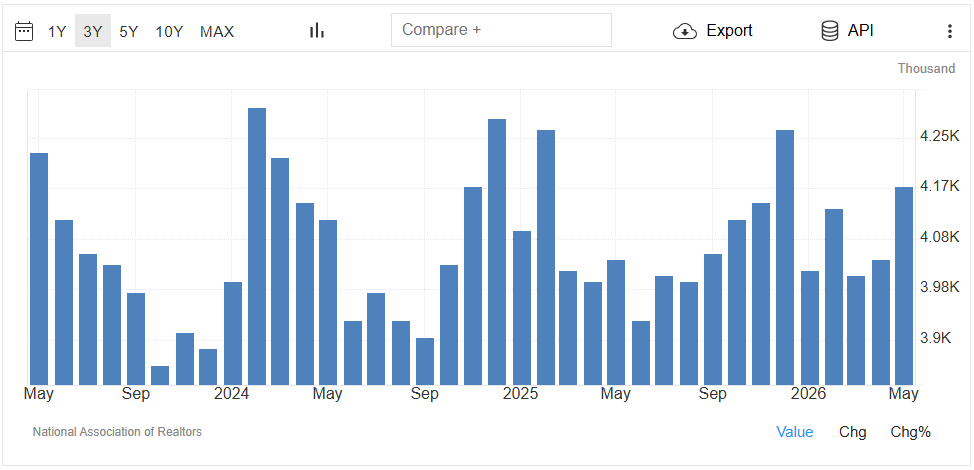
Existing Home Sales- U.S. existing-home sales for May broke out of their spring slump this morning, surging 3.2% month-over-month to a seasonally adjusted annual rate of 4.17 million units (up from 4.04 million in April). The print solidly beat consensus expectations of 4.07 million, marking the fastest pace of sales since December. On the pricing front, the median existing-home price notched a new record high of $429,300, up 1.3% year-over-year, driven by tight underlying supply fundamentals despite a 3.3% bump in monthly inventory to 1.55 million units (a 4.5-month supply). Regionally, sales growth was led by the Midwest (+6.4%) and South (+3.2%), while the West remained entirely unchanged. NAR Chief Economist Lawrence Yun noted that despite recent ticks higher in mortgage rates, the market is finding a floor as localized income gains begin to outpace price growth.
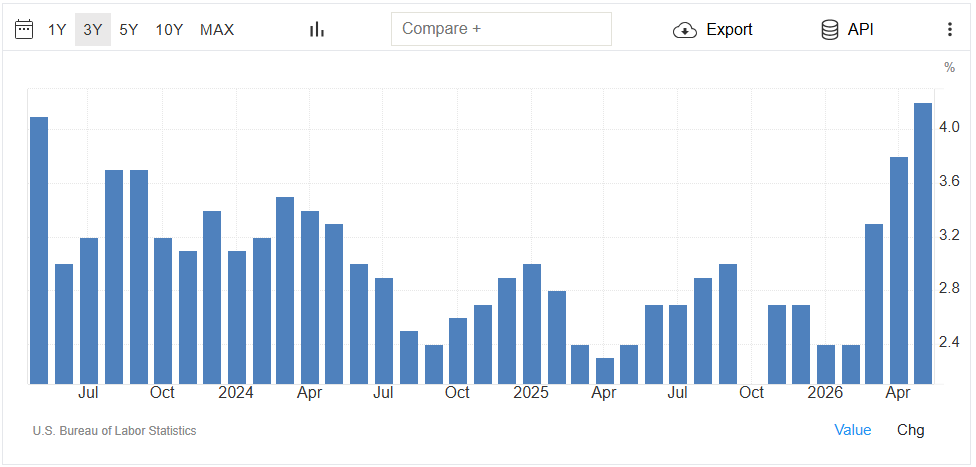
CPI- U.S. headline inflation accelerated for the third consecutive month in May, climbing to a three-year high of 4.2% year-over-year (up from 3.8% in April) and matching consensus forecasts. The print was heavily driven by the ongoing geopolitical energy shock in the Middle East, with monthly energy costs jumping 3.9%—accounting for over 60% of the aggregate monthly CPI increase (+0.5% MoM). Annual core CPI ticked up to 2.9% (vs. 2.8% prior), but the silver lining for fixed-income desks was the sequential core reading, which decelerated to a cooler-than-expected +0.2% month-over-month. While the softer underlying core data suggests that energy spikes aren't broadening out into structural goods and services just yet, the hot headline number heavily complicates the upcoming June 16–17 Federal Reserve policy meeting, cementing expectations that newly appointed Chair Kevin Warsh will keep rates higher for longer to anchor long-term expectations.
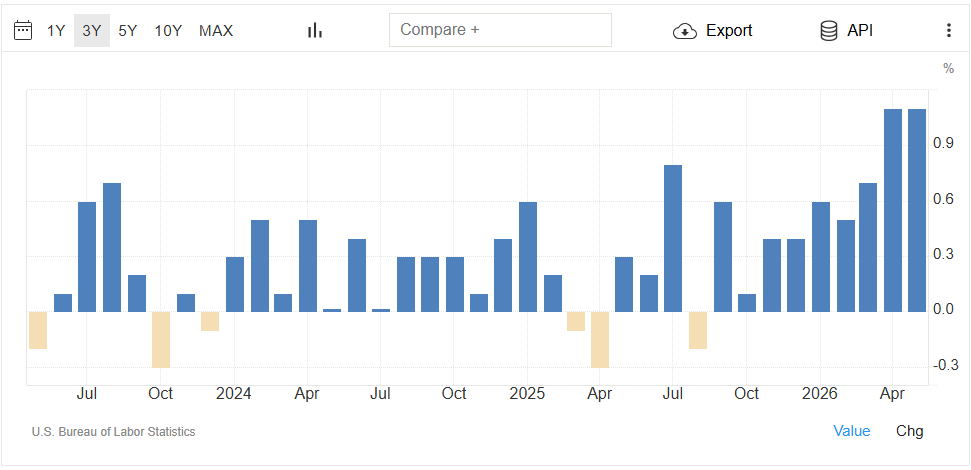
PPI- The May 2026 Producer Price Index (PPI) report delivered a significant headline miss, with final demand surging 1.1% MoM (above the 0.7% consensus) and accelerating to 6.5% YoY, marking the highest wholesale inflation print since November 2022. The upward drive was almost entirely an energy shock triggered by the ongoing closure of the Strait of Hormuz; final demand goods jumped 2.8% on the month, heavily penalized by a massive 23.4% spike in gasoline prices and an 11.8% lift in crude petroleum. Conversely, core PPI (excluding food and energy) offered a minor silver lining, printing at a cooler 0.4% MoM and holding steady at 4.9% YoY (beating the 5.4% consensus forecast). While core elements showed signs of stabilization, the severe headline pipeline pressure keeps fixed-income markets on edge regarding trailing impacts to future CPI prints and the upcoming FOMC policy path.
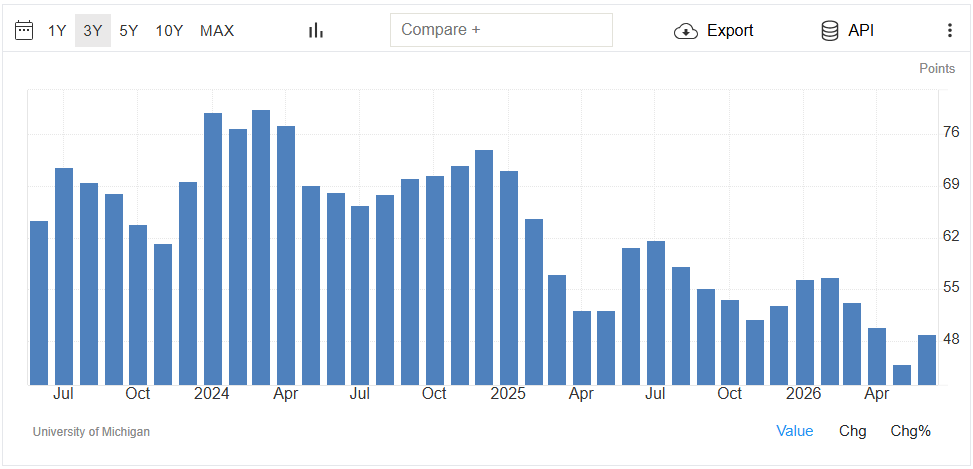
Consumer Sentiment- The preliminary June University of Michigan Consumer Sentiment Index bounced off May's record low, printing at 48.9 to beat the 46.0 consensus. The modest 9.2% month-over-month recovery was primarily driven by a brief, early-month relief in retail gasoline prices, sparking a notable sentiment lift among lower-income brackets where fuel commands a disproportionate wallet share. Crucially for the macro trajectory, inflation expectations took a step in the right direction: year-ahead expectations ticked down to 4.6% (from 4.8%), while long-run 5-to-10-year expectations retreated significantly to 3.4% from last month's alarming 3.9% spike. Despite the across-the-board improvement in both current conditions (48.4) and expectations (49.3), the index remains highly depressed—sitting roughly 19% below last year's levels—as persistent "kitchen table" anxieties surrounding core inflation keep overall consumer economic assessments decidedly sour.
The Main Course
The $3 trillion mega-cap IPO pipeline for SpaceX and Anthropic represents an unprecedented structural liquidity event that is fundamentally rewriting public market dynamics. To engineer successful debuts, underwriters are utilizing tiny initial floats—just 4.3% for SpaceX and an estimated 6.2% for Anthropic—to create artificial day-one scarcity, even as a staggering $2.5 trillion in locked-up insider equity looms over the horizon. While a newly amended Nasdaq rule will force index trackers to fast-track SpaceX into the Nasdaq-100 just 15 days post-listing, providing a massive wave of programmatic demand, the market must still contend with an unusual, highly volatile phased lockup structure that unlocks 20% of SpaceX insider supply this August. Ultimately, these staggering valuations—predicated on SpaceX's structural space monopoly and Anthropic's massive $47 billion revenue run-rate—are forcing institutional funds to aggressively de-gross and free up billions in raw cash, acting as a massive near-term capital vacuum across the broader technology landscape.
