
The Tech Monopoly on SPY Performance
Why a Narrow Market Signals a Looming Mean-Reversion

Shorter note this week as the U.S. markets were closed yesterday in observance of Juneteenth. The house has been eerily quiet for the past two weeks with the kids away, and I am hitting the road this weekend to pick them up from summer camp. I am incredibly excited to see them on Saturday, welcome them back home, and hear everything about the new friends they made and the memories they built over the past two weeks.
We’ve seen a clear technical dynamic play out over the past couple of months: a number of institutional names were aggressively unloaded across the street simply to free up the liquidity needed to absorb the massive wave of SpaceX (SPCX) supply that hit on Friday. While the borrow is finally opening up and you are technically able to short the name now, the retail hype and momentum behind it are still running on pure emotion. The smart play here is patience—you have to wait for the signal to confirm the regime shift before stepping in front of this freight train.
To put the current euphoria into proper historical context, consider this: Cisco (CSCO)—the absolute poster child of the 1999–2000 tech bubble—traded at a peak of 28x price-to-sales. SpaceX is currently commanding a valuation north of 152x price-to-sales. We are looking at textbook, peak dot-com insanity.
The real test comes this fall. When the next major wall of lock-up expirations and secondary supply hits the market, it is highly weaponized, and I do not know who the marginal buyer is on the other side to support these multiples. It’s deeply concerning to watch retail get sucked into this kind of extreme speculation, largely because retail advisors are jamming it down their clients’ throats with wild narratives about asteroid mining. It’s truly incredible what people will choose to believe when momentum replaces fundamental math.
“Markets can remain irrational longer than you can remain solvent.” — John Maynard Keynes
This classic Keynesian quote has never been more relevant than in today’s momentum-chasing, highly gamified market environment. I never like to step in front of a raging bull market—trying to short pure emotion is a quick way to get carried out on a stretcher.
But make no mistake: when this structural behavior starts to fracture—and the data will show it early—I will be flashing the risk-off signal to pivot defensively into lower-beta names. For now… Party on, Garth!
What I was reading and watching this week
Started a new book, Bad Company, which dives straight into the horror stories of private equity—exposing how companies are systematically gutted by sponsors whose sole mandate is margin expansion and short-term extraction.
The opening profile on Toys “R” Us is a classic case study in financial engineering over operational sanity. The playbook is identical every time: execute a massive Leveraged Buyout (LBO), saddle the target’s balance sheet with the very debt used to acquire it, and simultaneously drain liquidity through a parasitic stream of advisory, management, and transaction fees. Left structurally starved and crushed under the weight of toxic debt service, the business is left to rot until the refinancing wall eventually triggers a forced bankruptcy.
While these are case-specific stories, they expose a broader, systemic issue. There is an active roster of predatory players executing this exact playbook time and again hollowing out viable businesses for short-term financial engineering. The real tragedy isn't just the destruction of corporate balance sheets; it's the human cost. When these companies are left to rot, it completely shatters the lives of the dedicated, long-term employees who relied on those jobs to support their families.
Building Permits/Housing Starts- The U.S. housing market hit a significant wall in May as housing starts plummeted 15.4% to a seasonally adjusted annual rate of 1.177 million, missing the consensus estimate of 1.43 million by a wide margin and marking the lowest level of construction activity since the early days of the pandemic in 2020. While single-family starts saw a modest decline of 1.9% (882,000 annualized), the real destruction was concentrated in the highly volatile multi-family segment, which plunged from 529,000 to just 284,000 units. Leading indicators offered little hope for a quick reversal: building permits also slipped 0.7% to an annualized 1.413 million, pointing to continued deceleration ahead as builders capitulate to stubbornly high mortgage rates, persistent material costs, and weakening sentiment.
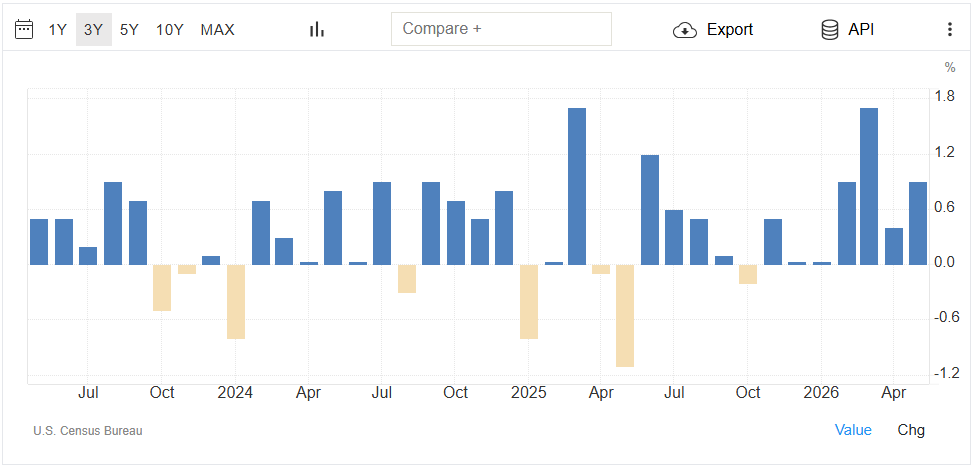
Retail Sales- The May Retail Sales print released by the Commerce Department this morning came in significantly hotter than expected, highlighting a consumer that is still spending heavily despite broader macro pressures. Total retail sales rose 0.9% month-over-month (to $763.7 billion), easily beating the consensus forecast of a 0.5% gain. This accelerates from a downwardly revised 0.4% increase in April. Year-over-year, total sales jumped 6.9%. The core takeaway is that while energy costs drove a large portion of the top-line number, underlying demand remains incredibly sticky.
FOMC Decision- The Federal Reserve held interest rates unchanged at 3.50% to 3.75% yesterday but paired the pause with a hawkish update to its economic projections. Driven by sticky inflation forecasts, the median dot plot for 2026 flipped from predicting cuts to signaling a target rate of 3.8% by year-end, with half of the committee now favoring a rate hike. New Fed Chair Kevin Warsh reinforced this shift by abandoning traditional forward guidance, committing instead to a strictly data-dependent, meeting-by-meeting stance.
The Side Dish
Python
Coe our
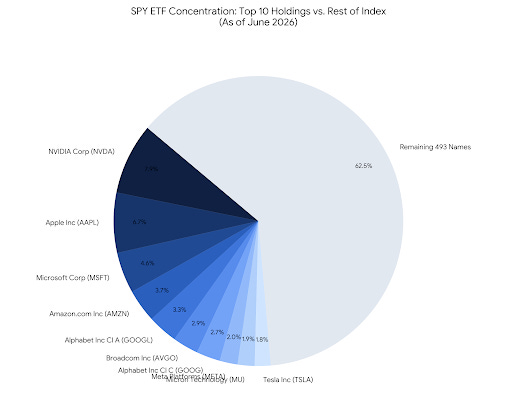
The chart above breaks out the current top 10 individual allocations inside SPY versus the remaining aggregate weight of the index.
